Small Island, Enormous Life: The Science Behind Puerto Rico's Staggering Biodiversity
Photo: Godot13, CC BY-SA 4.0, via Wikimedia Commons
Let's start with a number that puts things in perspective: Puerto Rico covers roughly 3,500 square miles. For context, that's smaller than the state of Connecticut. And yet, within that compact stretch of land and surrounding waters, scientists have documented over 3,000 plant species, hundreds of bird species, and countless invertebrates, amphibians, and marine organisms — many of which exist nowhere else on the planet. If you've ever wondered why conservation scientists treat this island like it's one of the most important places on Earth, the answer is buried in its geography.
When Geology Sets the Table
Puerto Rico didn't just appear in the Caribbean by accident. The island is the product of volcanic activity and tectonic uplift that began around 130 million years ago, making it geologically older and more complex than many of its Caribbean neighbors. That ancient origin matters because it gave the island time — enormous stretches of time — for species to evolve, diverge, and adapt to highly specific local conditions.
The interior mountain range, the Cordillera Central, rises to over 4,000 feet at Cerro de Punta. That elevation creates a dramatic range of microclimates stacked on top of each other. You can drive from the arid, cactus-dotted southwest coast near Guánica to the cloud-drenched peaks of El Yunque in under two hours and feel like you've crossed multiple continents. Each of those transitions — coastal scrub, dry forest, moist limestone karst, montane rainforest — supports its own distinct community of species.
El Yunque National Forest alone contains four distinct forest types across its roughly 28,000 acres. The tabonuco forest at lower elevations gives way to palo colorado forest higher up, then sierra palm forest, and finally elfin woodland near the peaks, where trees grow gnarled and low under near-constant cloud cover. Each layer is its own ecological world.
The Isolation Effect
Island biogeography — the study of how species colonize and evolve on islands — has a central principle: isolation drives specialization. When a species arrives on an island and finds no direct competitors, it often adapts rapidly to fill niches that wouldn't be available on a mainland. Puerto Rico has been running that experiment for millions of years.
The result is an extraordinary rate of endemism — species found nowhere else. Puerto Rico's endemic species list includes around 240 native bird species and subspecies, with standouts like the Puerto Rican parrot (Amazona vittata), one of the rarest birds in the world, and the Puerto Rican tody, a tiny jewel-green bird that somehow became the unofficial mascot of every birdwatcher who visits the island. The critically endangered Puerto Rican nightjar and the broad-winged hawk round out a bird community that evolved largely in geographic isolation.
And then there's the coquí. Puerto Rico has 17 native species of these small tree frogs, each adapted to a specific elevation or habitat type. The mountain coquí (Eleutherodactylus portoricensis) lives only in the high-elevation forests of the Cordillera Central. The web-footed coquí (Eleutherodactylus karlschmidti) is so specialized to cool mountain streams that it has likely already been lost to extinction. The diversity within just this one genus of frogs tells you everything about how fine-grained ecological adaptation gets when you have enough time and enough geographic variation.
The Karst Zone: A Hidden World of Biodiversity
Puerto Rico's northern limestone karst region doesn't always get the spotlight it deserves in conversations about biodiversity. The haystack hills — called mogotes — that define this landscape look almost otherworldly from above. Underground, the karst system is riddled with caves, sinkholes, and subterranean rivers that host species adapted to complete darkness over thousands of generations.
The Río Camuy Cave Park protects a portion of this system, but the karst zone extends across a wide swath of the island's north coast. Cave crickets, blind shrimp, and specialized bat species all rely on this underground geography. Puerto Rico supports 13 native bat species, many of which use karst caves as roost sites. Bats here aren't just ecologically interesting — they're critical pollinators and seed dispersers for the island's forests.
Coastal and Marine Density
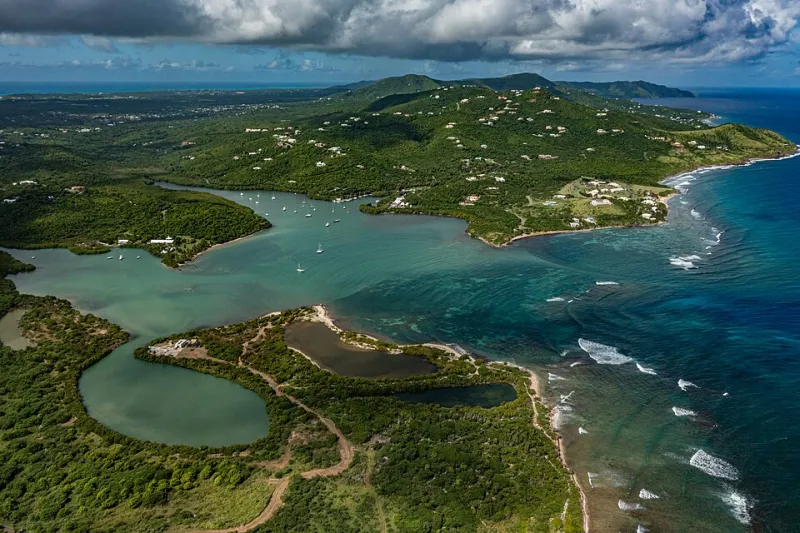
The biodiversity story doesn't stop at the shoreline. Puerto Rico sits within the Caribbean biodiversity hotspot, a region recognized by Conservation International as one of the most species-rich and most threatened on Earth. The island's surrounding waters contain coral reef systems, seagrass meadows, and mangrove forests that function as nurseries for fish, sea turtles, and invertebrates.
Leatherback, hawksbill, and green sea turtles all nest on Puerto Rican beaches. The southwest coast's Bahía de Jobos and the mangrove lagoons near Fajardo serve as critical habitat corridors between reef and land ecosystems. Lose the mangroves, and you don't just lose trees — you lose the nursery habitat that sustains reef fish populations that feed communities across the island.
Why This Matters for US Students and Travelers
Here's the thing that often surprises American visitors: Puerto Rico is a US territory, which means its biodiversity is, in a very real sense, American biodiversity. The Puerto Rican parrot recovery program is run by the US Fish & Wildlife Service. El Yunque is the only tropical rainforest in the US National Forest system. The conservation battles happening on this island are happening under the US flag.
For students studying ecology, conservation biology, or environmental science, Puerto Rico offers a condensed classroom where you can observe island biogeography, endemic species, climate gradient ecology, and human-wildlife conflict all within a few days of travel. You don't need to fly to Madagascar or the Galápagos to encounter a living laboratory of evolutionary biology — it's a direct flight from Miami or New York.
For travelers, understanding the biodiversity context transforms a beach vacation into something richer. That frog you hear at 2 a.m. from your hotel balcony? It's a species that evolved on this island and exists nowhere else on Earth. The parrot you might spot in El Yunque if you're patient and lucky? There are fewer than 500 of them left in the wild. These aren't abstract conservation statistics — they're the specific, irreplaceable result of millions of years of geographic and evolutionary history unfolding on a small island in the Caribbean.
Protecting that history isn't just Puerto Rico's job. Given the island's status and the US government's role in its land management, it's a shared responsibility — and one worth understanding before you arrive.