Singing for Survival: The Coquí Frog and the Race to Protect Puerto Rico's Shrinking Wild Spaces
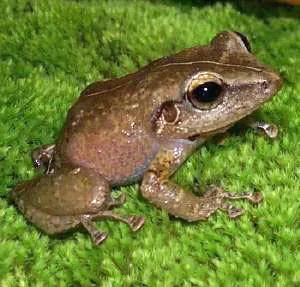
Photo: United States Department of Agriculture, Public domain, via Wikimedia Commons
If you've ever spent a night in Puerto Rico, you know the sound. Starting around dusk, a chorus of tiny voices rises from the trees, the bushes, even the potted plants on hotel patios. Ko-KEE. Ko-KEE. It's relentless, layered, and—once you've heard it—unforgettable. That's the coquí, a thumbnail-sized tree frog that has become Puerto Rico's most recognizable symbol.
There are 17 known species of coquí native to Puerto Rico. Most exist nowhere else on the planet. And right now, several of them are in serious trouble.
The story of the coquí's struggle is also the story of Puerto Rico's landscape—how it's being reshaped by human decisions, economic pressures, and a climate that seems to be shifting the rules of the game. It's a story that matters far beyond the island's borders.
A Frog That Can't Go Anywhere Else
Endemism—the condition of being native to and found only in one specific place—is both a badge of ecological distinction and a vulnerability. The coquí's entire evolutionary history is tied to Puerto Rico's forests, streams, and humid hillsides. Unlike migratory birds that can shift their range northward as temperatures warm, or fish that can follow cooler water to new depths, coquís are stuck. Their habitat moves, or disappears, and they have nowhere to go.
Of the 17 species, at least 7 are currently listed as threatened or critically endangered. The golden coquí (Eleutherodactylus jasperi) hasn't been confirmed alive in the wild since the 1980s. The web-footed coquí clings to a handful of high-elevation stream habitats. These aren't abstract statistics—they represent entire branches of evolutionary history on the verge of being erased.
Herpetologists at the University of Puerto Rico and partner institutions have been tracking population trends for years. The findings are sobering: species that were once common in mid-elevation forests have contracted into smaller, more fragmented ranges. The common coquí (E. coqui)—the one you hear at every hotel and roadside stop—is still doing okay. But "common" doesn't mean invincible, and its more specialized cousins are already gone from large portions of their historical habitat.
Development Pressure: The Map Is Changing Fast
Puerto Rico has faced intense development pressure since the mid-20th century, and that pressure has only intensified in recent decades. The island's population is concentrated in a coastal ring around San Juan and in urban centers like Ponce and Mayagüez, but suburban sprawl has steadily pushed into areas that were once forested hillsides and agricultural buffer zones.
Housing developments, road expansion, and commercial construction have fragmented the landscape in ways that are particularly damaging to species like coquís, which have limited mobility and depend on continuous forest cover. When a road cuts through a forest, or a subdivision replaces a hillside, it doesn't just remove habitat—it creates barriers that isolate populations, reducing genetic diversity and resilience over time.
Coastal development adds another layer of complexity. Puerto Rico's beaches and shorelines are among the most economically productive real estate on the island, and the pressure to build hotels, condos, and tourism infrastructure near the water has compressed the coastal ecosystems that many species depend on. Mangrove forests, which serve as nurseries for marine life and buffers against storm surge, have been significantly reduced over the past 50 years.
For U.S. travelers who've watched similar patterns play out in Florida, Hawaii, or coastal California, the dynamics will feel familiar. The tension between economic development and ecological preservation is one of the defining geographic conflicts of our time, and Puerto Rico is living it in a particularly concentrated form.
Climate Change: Turning Up the Pressure
On top of development, climate change is rewriting the conditions that Puerto Rico's endemic species evolved to expect. The island has experienced measurable increases in average temperature over recent decades, and projections suggest continued warming through the end of the century. For cold-blooded animals like frogs, temperature shifts aren't just uncomfortable—they can disrupt reproduction, alter disease dynamics, and shift the timing of rainfall that many species depend on.
Drought is a growing concern. Puerto Rico's southern and western regions have experienced increasingly severe dry periods, stressing freshwater ecosystems that support aquatic coquí species. Hurricane María in 2017 offered a brutal preview of how extreme weather events can reshape the landscape almost overnight—stripping forest canopies, flooding streams, and displacing wildlife populations that took decades to establish.
Researchers studying post-María recovery found that coquí populations in heavily impacted forest areas dropped dramatically immediately after the storm, then began a slow rebound as vegetation recovered. The concern isn't that a single hurricane wipes out a species—it's that more frequent and intense storms, combined with habitat fragmentation, leave populations with less room to recover between events.
What's Being Done (And What Needs to Happen)
Conservation efforts on the island are real and ongoing, even if they're often underfunded and racing against fast-moving threats. The U.S. Fish and Wildlife Service manages several wildlife refuges in Puerto Rico, and El Yunque National Forest provides protected habitat for multiple coquí species. Local organizations like Para La Naturaleza have worked to acquire and restore private lands with high conservation value, stitching together habitat corridors that give wildlife more room to move and adapt.
Captive breeding programs for the most critically endangered species represent a last-resort safety net. Scientists at institutions including the Puerto Rico Department of Natural and Environmental Resources have maintained captive populations of rare coquís with the hope of eventual reintroduction, though reintroduction only works if suitable habitat still exists to receive them.
Zoning reform is another piece of the puzzle. Puerto Rico's land-use planning has historically prioritized development, but there's growing advocacy—from scientists, community groups, and some local officials—for stronger protections around ecologically sensitive areas, particularly the karst region in the northwest and the remaining forest patches in the interior.
Why This Matters to You
If you're a student studying environmental science or human geography, Puerto Rico's situation is a real-world case study in how physical and human geography collide. The island's endemic species didn't evolve in isolation from human activity—they evolved alongside Indigenous Taíno communities for thousands of years. What's new is the speed and scale of modern development, and the additional wildcard of a destabilizing climate.
If you're a traveler, the coquí's situation is a reminder that the natural experiences you come to Puerto Rico for—the sounds, the biodiversity, the sense of being somewhere genuinely unique—aren't guaranteed. They depend on choices being made right now about land use, development, and conservation funding.
The coquí still sings in Puerto Rico. Drive into the hills above San Juan at dusk, pull over, and roll down your windows. The chorus will find you. But behind that familiar sound is a more complicated story—one that every visitor to the island deserves to know.